





The problem of salinity in plant medium
One of the common problems with houseplants is the browning and drying of the tips and margins of the leaves. This problem usually stems from the high salinity of the growing medium.
But what is salinity? After all, we don't add cooking salt to our irrigation water
The term salt is misleading in this case and refers to many compounds that contain common minerals and elements such as chlorine, sodium, calcium, potassium, and others.
These elements are mostly necessary for plants and are found in different concentrations in different soils.
Plant species that develop in certain areas also adapt themselves during evolution to the concentrations of salts in the soil, and thus there will be plants that successfully cope with excesses or deficiencies of minerals in the soil.
When we grow in the garden plants that come from different regions of the world, a problem of compatibility with the soil may also arise. For example, in tropical areas that receive large amounts of rain, the salts are washed away from the soil because the rain is actually distilled water (pure water free of salts). In contrast, in desert areas, the soil salinity (concentration of minerals in the soil) is almost always very high due to the lack of rain. Therefore, it can be expected that many tropical plants will have difficulty coping with the salt-rich desert soil, even if other conditions are suitable for them.
High concentrations of minerals in the soil can also impair the plant's ability to absorb water from it and absorb trace elements such as iron and magnesium that are necessary for its development.
In this context, it is important to note that excess fertilization or irrigation with gray water and even improper irrigation with regular tap water can also increase soil salinity!
In our Mediterranean climate, even with the limited amount of rainfall, there is still a reasonable leaching of salts in the soil every winter. Still, one should be aware of this factor and adjust the level of fertilization, the irrigation method and sometimes even the type of soil to the requirements of the plants.
:In the case of houseplants, there is a combination that exacerbates the problem
- Indoors, the substrate is not leached by the rain.
- Most houseplants come to us from tropical climates and these, as mentioned, are used to soils poor in salts and are therefore also particularly sensitive to excess salts.
- Most of us irrigate our houseplants with tap water, and in Israel this water contains a little chlorine and a lot of calcium, which are not liked by most tropical plants.
- Indoors, we prefer not to flood the pot with water, so there is rarely any leaching of the substrate.
For all of the above reasons, salinization of the substrate in houseplants is very common. In some plants, the results of salinization can be seen within a few months, and in others, the process takes years.
?What do you see
The plants transport water to the leaves, from where the water evaporates during photosynthesis or when the plant has excess water. The transport tubes end at the tips of the leaves, and when the water leaves, the salts remain there, and when they accumulate to high levels, the tissues suffer and turn yellow/brown/black and dry out. This is the most noticeable phenomenon and appears mainly in mature leaves after a while. When the plant suffers greatly, we sometimes see the development of deformed leaves or the degeneration of the entire plant.
In many cases, you can see the accumulation of a white layer of salt on the surface of the soil or on the edges of the container.
:Don't worry- there are several possible solutions
It is necessary to ensure that fertilization is at an appropriate and not excessive level – as we mentioned earlier, fertilizers are also concentrated salts.
Water with distilled water or highly filtered water (note that chlorine and calcium in drinking water are considered healthy for humans and therefore will not always be filtered by household appliances).
Water with tap water with a rinse of the growing medium every few weeks – you can place the pot outside or in a bathtub and run a large amount of water through it.
Change the medium every few years. Salts also tend to accumulate on the container and are sometimes absorbed into clay pots. It is worth washing and cleaning the container itself, and if it seems to be soaked in salt, even throw it away or move it to the garden and plant tougher plants in it. Check the saucers for excess salts and wash them too.
In the garden, it is also worth being aware of the issue of salinization and monitoring the appropriate signs in the plants. In certain areas and on particularly problematic soils, it is worth replacing the top layer of soil before planting. In other cases, you can water deeply once in a while in order to lower the salt level.
Remember that frequent and shallow irrigations, especially if accompanied by heavy fertilization, can produce salinization in the topsoil layer in the garden as well.
This is doubly true in desert areas or after dry winters, but could happen even in normal years. Citrus trees, for example, which are relatively sensitive to soil salinization compared to other trees, often show burns resulting from salinization. Proper watering and fertilization usually solve the problem.


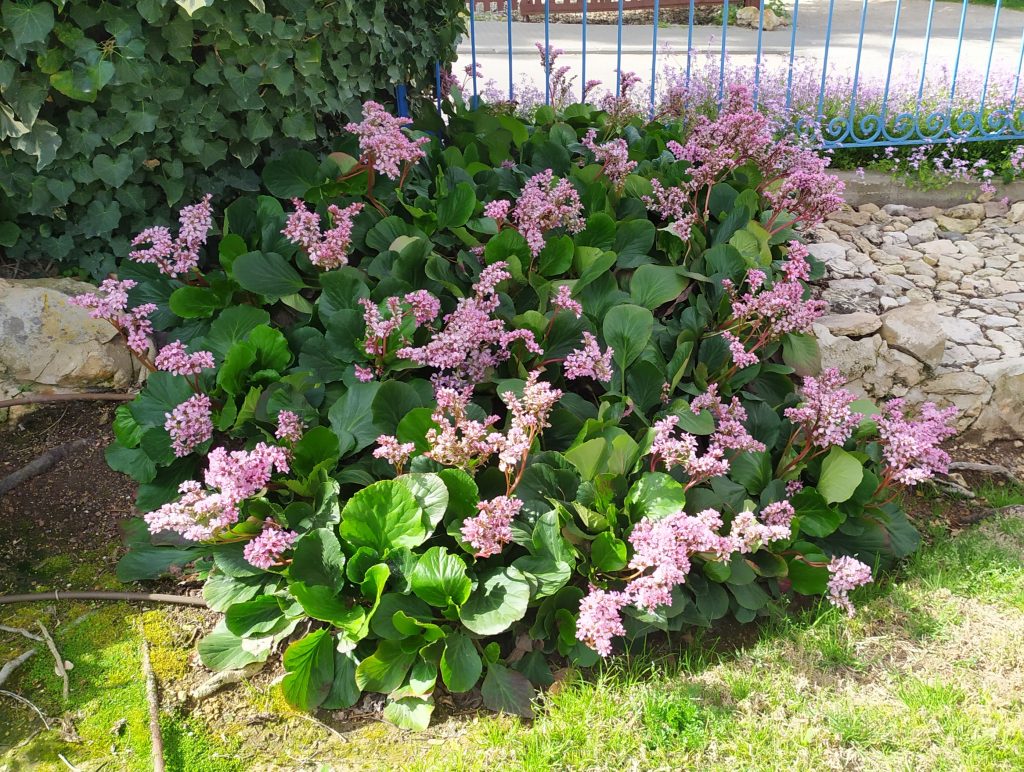
Bergenia x schmidtii
Schmidt's Bergenia blooms in the shade for the whole length of our winter and also has impressive leaves. Furthermore, it is very long-lived!
This is a sprawling plant with large, smooth and wide leaves of a vivid green color that grow from short, thickened stems and form a clump about 20-30 cm high and 50-70 cm wide.
It is also relatively drought-tolerant and resistant to root competition under trees, but in severe root competition it will prefer to grow in a container. For best results one should water it regularly and fertilize it about twice a year.
Most species of bergenia are cold-resistant, but suffer from prolonged heat, and other varieties of bergenia, tested in Israel, were found to be sensitive to heat and degenerated within a few years.
Schmidt's Bergenia, on the other hand, was tested even in the Jordan Valley and survived very hot summers there, despite the fact that the two plants suspected of being its parents, bergenia ciliata and bergenia cordifolia, do not grow successfully even in the Jerusalem area.

Nandina domestica
Have you ever walked down the street and seen a shrub that is covered in winter with panicles of red fruits and resembles a Japanese painting? It is likely that this was a shrub of Nandina domestica.
Nandina domestica or Heavenly Bamboo has been used in Israeli gardening for many years. It is a successful, robust and long-lived plant, but still not well-known and appreciated enough.
This evergreen shrub, which originates from China and Japan, grows in most areas of the country from full shade to partial sun and even under full sun in the mountain area and flourishes even under trees with root competition and relatively little irrigation.
The shrub also blooms in clusters of white flowers that turn into beautiful red berries that attract birds and is ablaze with spectacular autumn and winter colors in a season when the garden lacks color.
For the full article press here


One of the common problems with houseplants is the browning and drying of the tips and margins of the leaves. This problem usually stems from the high salinity of the growing medium.
For all of the above reasons, salinization of the substrate in houseplants is very common. In some plants, the results of salinization can be seen within a few months, and in others, the process takes years.
For the full article press here

?Did you know
Super Lang Ltd. was established in 1995 as a professional center that offers all the solutions for private garden owners, gardeners and institutions.
Today, the store contains a wide variety of tools, clothing, footwear and everything you need for pleasant, professional and safe work environment.
In addition, the store holds camping and outdoor equipment as well.
As part of Super Lang's professional service, it opened the 'Workshop' – a repair center for all motorized and electric gardening tools – from saws to lawn mowers.
So if you haven't visited yet, now is the time – the store is located inside the nursery!
We hope to see you soon.
ניתן לצפות בסרטונים שלנו ולהתעדכן בנעשה במשתלה בעמוד הפייסבוק, באינסטגרם וגם בערוץ היוטיוב שלנו, בו יש כבר למעלה מ-100 סרטונים