
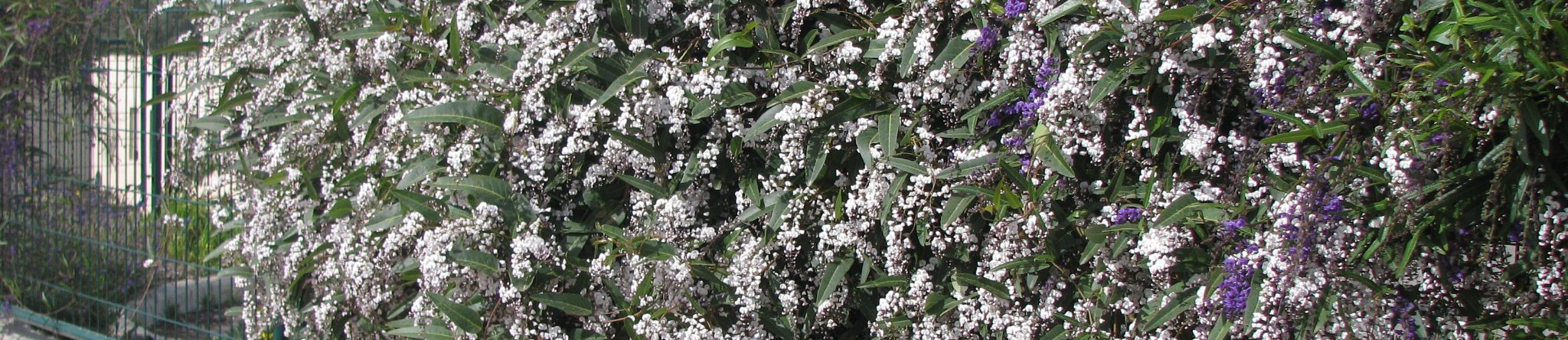
Hardenbergia violacea (and comptoniana)
Family: Papilionaceae | Origin: Hardenbergia violacea from southwestern Australia and Hardenbergia comptoniana from eastern and southern Australia
Many Australian plants have acclimatized to gardening in Israel and thrive in a climate similar to the one they came from. One of the most impressive of these is Hardenbergia – a large, fast-growing evergreen climber with twining branches and dark green, lanceolate or clover-shaped leaves. The plant bears dense clusters of purple or white butterfly flowers, the first buds opening in February and it is completely covered in an enormous abundance of flowers by March or April.
Hardenbergias grow well in all soils and in most areas of the country from partial shade to full sun with regular irrigation. On the coastal plain, it suffers a little in the summer, and fares better if planted in partial sun. One can also combine it on large fences with summer-flowering climbers, thus obtaining a long and varied flowering season.
When mature, Hardenbergias develop good drought resistance.
:Important to know
This plant has a tendency to climb up – a nearby tree will be quickly covered, and a high wall topped by a fence will remain exposed at the bottom. Therefore, it is recommended mainly for fences up to 3 meters high or, as we have already suggested, in combination with other climbers.
It is also possible that it suffers from exposure of the base of the branches to intense sun, so it is worth letting it, or other plants, cover its lower part.
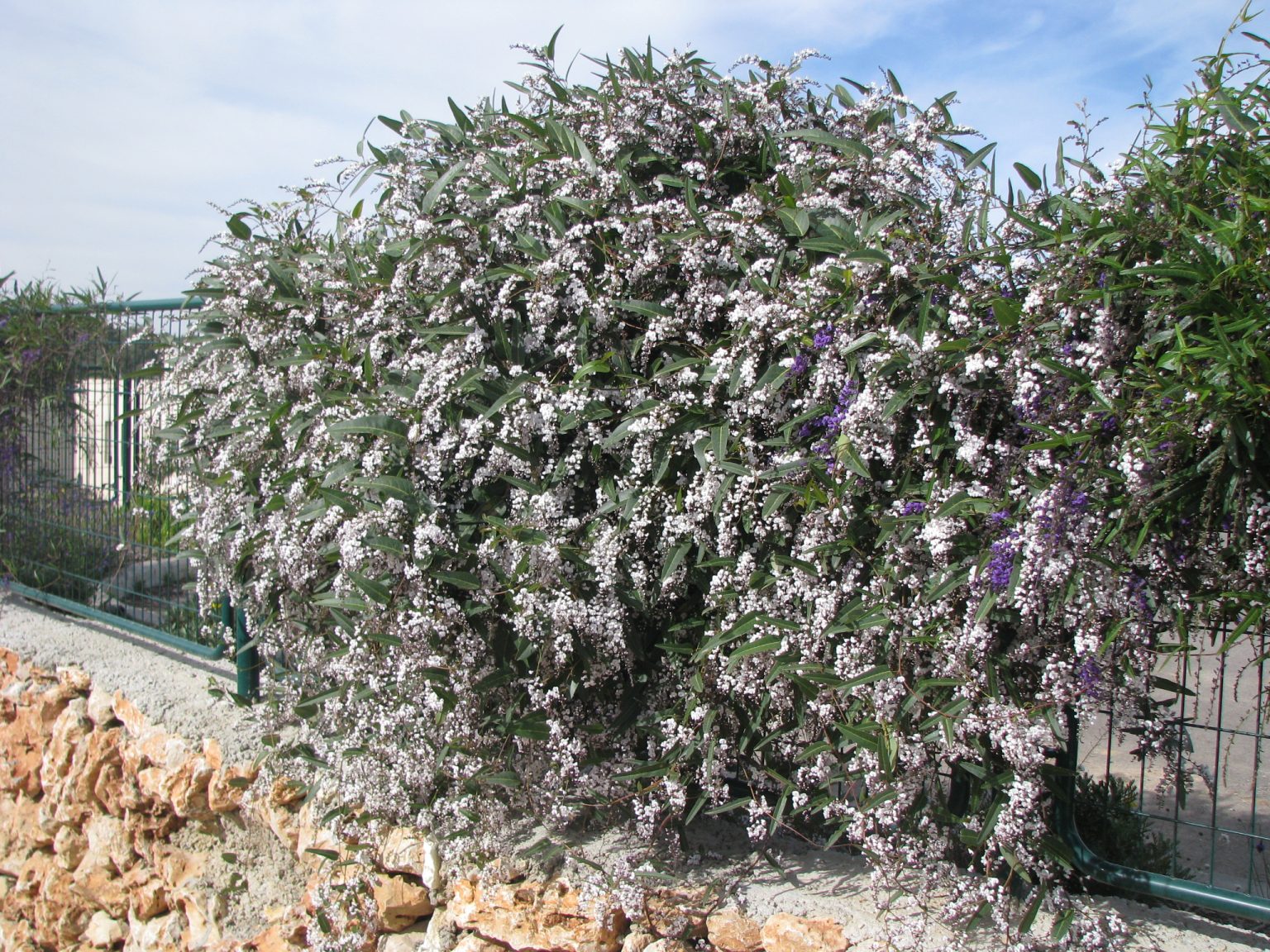
In the past, the clover-leafed Hardenbergia, with leaves divided into 3-5 leaflets, was widespread in Israel, but it seems that in recent years this species has been replaced by the purple and white varieties of the simple-leaved Hardenbergia, which is a close and very similar species.
In our experience, Hardenbergias look their best for about 7-15 years, after which they weaken or completely degenerate, although beautiful plants that are about 20 years old are known in the mountain area. Excessive watering or drainage problems can accelerate this weakening process, so it is worth planning the planting site accordingly.
This is a recommended climber with very early and impressive flowering, and due to its rapid growth, we recommend it even if one has to replace it in the garden once every ten years.
The plant was named in honor of the 19th century Countess Franziska von Hardenberg. She and her more famous brother, Karl von Hoegel, were Austrian nobles and patrons of botany. Their ancient family probably owned a fortified German castle, which sat on a hill, hence the meaning of the name strong mountain or strong hill.
The next time you admire the beautiful bloom of your Israeli Hardenbergia, please think about the landscapes of its homeland in Australia and the ancient German castle that gave it its name.
And back to the here and now: Come to the nursery now to purchase beautiful Hardenbergias in bloom!
