
Nandina domestica – Heavenly Bamboo
Family: Berberidaceae | Origin: China and Japan
Have you ever walked down the street and seen a shrub that is covered in winter with panicles of red fruits and resembles a Japanese painting? It is likely that this was a shrub of Nandina domestica.
Nandina domestica or Heavenly Bamboo has been used in Israeli gardening for many years. It is a successful, robust and long-lived plant, but still not well-known and appreciated enough.
This evergreen shrub, which originates from China and Japan, grows in most areas of the country from full shade to partial sun and even under full sun in the mountain area and flourishes even under trees with root competition and relatively little irrigation.
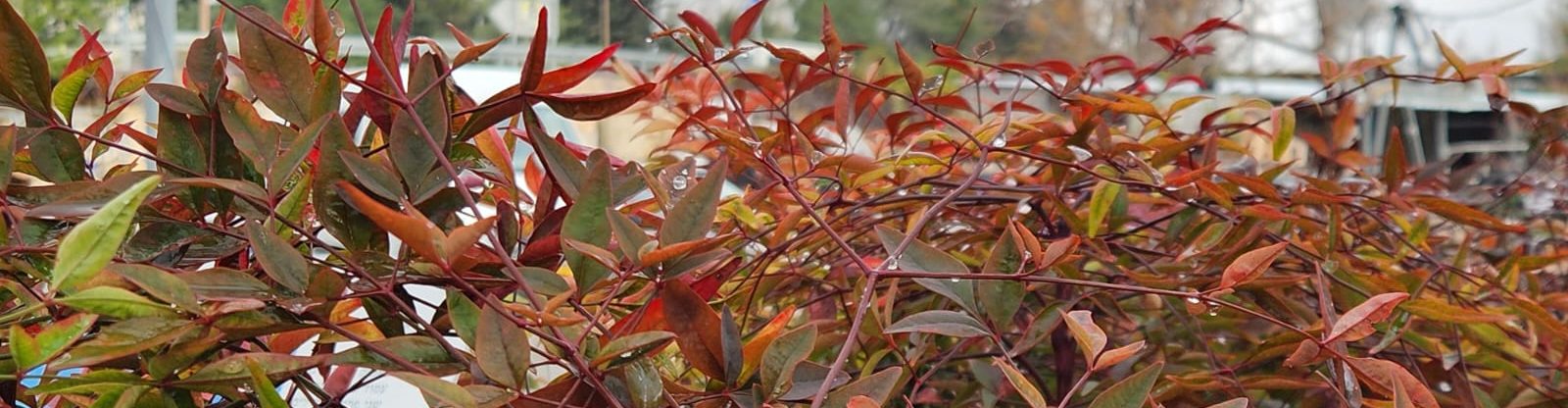
The feathery leaves emerge pink-reddish and turn green as they mature. In late autumn as the weather cools and with at least some direct sunlight their color changes to shades of pink-orange-and-red. They retain these fall colors until spring without falling off the plant.
The shrub also blooms in clusters of white flowers that turn into beautiful red berries that attract birds and is ablaze with spectacular autumn and winter colors in a season when the garden lacks color.
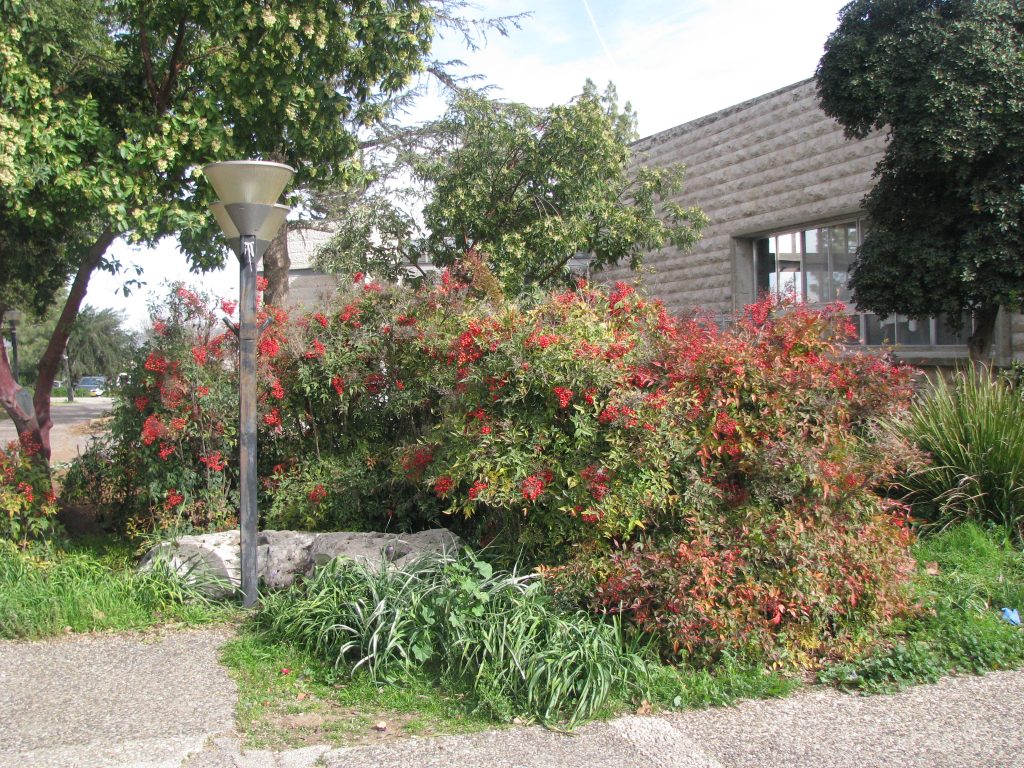
Nandina domestica has a narrow and upright growth and the stem, which does not split, can reach a height of 2 meters or more when mature. The shrub also fills out slowly by growing additional stems from short underground shoots, thus creating over the years a clump with a diameter of a meter or more, whose color changes pleasantly throughout the year.
This is a shrub recommended for almost any corner of the garden, as a hedge, as a central sculptural focal point or behind low shrubs that is also successful as a filler under trees.
Similarly, it can be planted in medium and large containers where it will succeed for many years despite its tendency to crowd.
It prefers regular watering, but in its maturity can survive prolonged periods of drought. If necessary, it can be pruned to a smaller size at the end of winter.
We do not recommend planting it in areas exposed to strong winter winds in the high mountains, as it may shed the leaves and lose its spectacular appearance.
In conclusion – a special and beautiful shrub all year round, whose winter appearance, reminiscent of a the northern fall colors, is particularly endearing and is highly recommended for any garden!
לקריאה על ננדינה תרבותית בעברית לחצו כאן
